Key takeaways
- Set your diet in FIG once and places that do not fit drop out of your results. Filters are a starting point, not a guarantee.
- For an allergy, always confirm with the restaurant itself, before you go and again when you order.
- Call the restaurant before you go with a short, specific question.
- Ask about ingredients, shared equipment and how the dish is made, not just 'is it safe?'.
- This is general information, not medical advice. Follow your doctor's guidance for your own allergy.
The short answer
Use FIG's diet filters to narrow the list, then ask the restaurant about your exact need before you go. Filters tell you where to look. Only the kitchen knows what is in a dish, what it was cooked beside and who is working today. For an allergy, check twice: once on the phone before you go, and again when you order. This guide is general information, not medical advice.
Step 1: set your diet once
When you set up FIG, you choose what you crave, your budget and your diet: halal, vegetarian, vegan, gluten-free and more. After that, Home and the map show live deals from places that fit, nearest first, and the others drop out. Deals start in Markham on January 1, 2027, and you can explore the map and restaurants now.
It saves a lot of scrolling, and it helps groups too: set the group's must-haves before you share options, so everything you send already works for everyone. Eating out as a group.
Step 2: know what a filter can and cannot tell you
| A filter can tell you | It cannot tell you |
|---|---|
| This place has options for your diet | That every dish on the menu is suitable |
| Which restaurants to look at first | What was cooked on the same grill or fryer |
| That the restaurant chose to list that diet | Whether today's recipe or supplier changed |
| A good place to start | That an allergy is safe |
Words like halal, vegan and gluten-free can mean slightly different things in different kitchens. If the exact meaning matters to you, ask what it means at that restaurant.
Step 3: call before you go
Call the restaurant before you go. A good question is short, specific and gives the kitchen something to answer. Some examples to adapt:
- "Hi, I'm vegetarian. Is the mushroom noodle bowl made without meat stock?"
- "I have a peanut allergy. Does the kitchen use peanut oil or peanut sauces, and can the dish I'm planning be made without them?"
- "Do you have a gluten-free option, and is it cooked on separate equipment?"
- "I'd like to use the 2-for-1 on the dumplings. Are the vegetable ones vegan?"
A busy kitchen at 6 pm may not have time to talk, so call earlier in the day, or choose a quieter hour when staff can give you attention.
Step 4: ask the right questions
"Is it safe?" is a hard question to answer yes or no. Better questions let the kitchen tell you what it knows:
- Ingredients. What is in the dish, the sauce and the broth?
- Hidden sources. Is there butter, fish sauce, soy, nuts, egg, wheat or dairy in the sauce, marinade or garnish?
- Shared equipment. Is it cooked on the same grill, fryer or board as other foods?
- Changes. Can the dish be made without the ingredient, and will the kitchen change how it is cooked, or only leave something off the plate?
- Who is cooking. Does the person taking your order know your need? Ask them to pass it to the cook.
Step 5: say it again when you order
Menus, recipes and staff change. Even if you called earlier, tell your server when you order: "I have a shellfish allergy, as I mentioned on the phone." Say it at the table and at the counter, and again if a different person brings the food. If you are not sure about something you are served, ask before you eat it. If the answer does not satisfy you, it is fine to say no thank you.
Deals and dietary needs
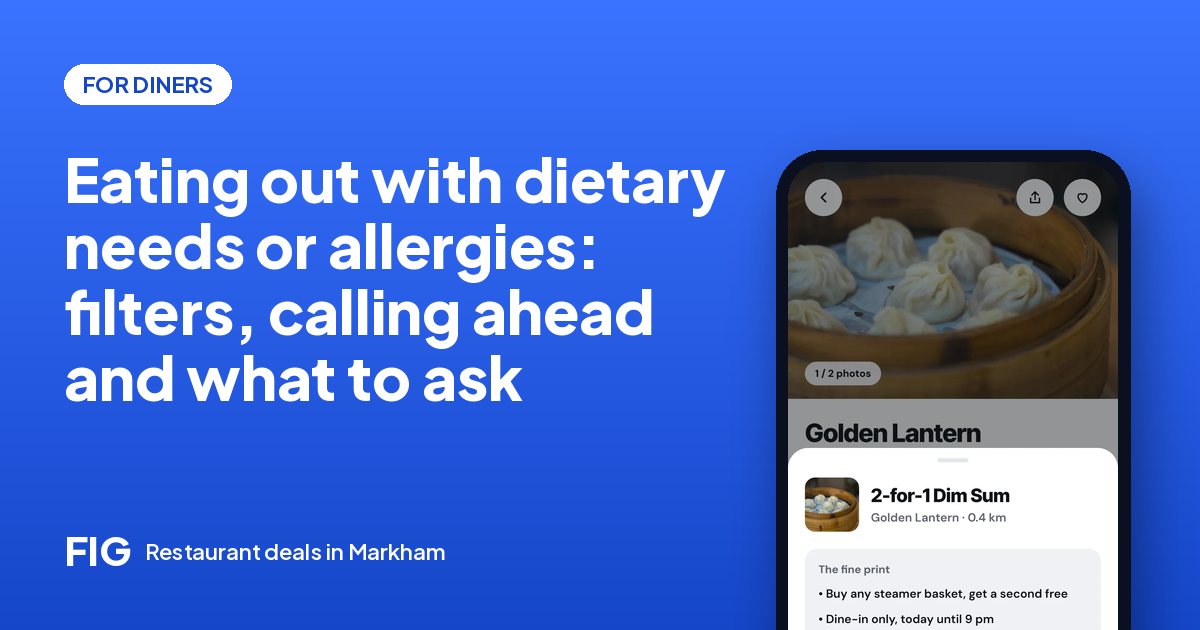
A deal only helps if you can eat the dish. Check which dishes the deal covers: some are on specific dishes, others on the whole order. If the covered dish does not suit you, call the restaurant and ask whether the deal can apply to something that does. The answer is the restaurant's call. A 2-for-1 on a dish you cannot eat is not a deal. How to compare restaurant deals.
Takeout with a dietary need
When you order takeout with a deal, call the restaurant for changes: no onions, extra sauce on the side, or a note about an allergy. When you collect the food, check the bag against the order before you leave. How takeout with a deal works.
If you are the restaurant
Owners reading this: the more precisely your page, menu and replies describe what you can do, the more trust you earn. Keep ingredient and allergen information current, answer questions promptly, and be honest when you cannot guarantee something. A diner who hears "we cannot guarantee a nut-free kitchen" and chooses to come anyway, or goes elsewhere, is a better outcome than a mistake. Only diners whose visit was scanned can review, and you can reply in public. How reviews work on FIG.
Talking to staff kindly and clearly
Kitchens are busy, and the easiest way to get a good answer is to make it easy to give. Lead with the need, then the question: "I'm allergic to sesame. Can you tell me which dishes have it?" is clearer than "what's safe here?". Thank the person who checked for you, even if the answer is that the kitchen cannot do it. A restaurant that tells you honestly what it cannot promise is looking after you. If you eat out often with the same need, a short note saved on your phone, with your allergy and the foods to avoid, saves you typing it each time.
Going with friends or family
If you are eating with a group, tell the person organising before the restaurant is chosen, not at the table. Share a deal that you have already checked, so nobody has to change plans on the day. If you are taking a child with an allergy, say the need first when you call so the restaurant hears it straight away. For a big group, call earlier and ask whether the kitchen can handle it in a quiet hour rather than at peak dinner. Quiet hours are often better for questions as well as for deals.
A short checklist
- Set your diet in FIG and shortlist two or three places.
- Call each with a specific question.
- Pick the one that answered clearly.
- Claim the deal and go in a quieter hour.
- Tell your server your need when you order.
- Afterwards, rate the visit and name the dish. Your review helps the next diner with the same need.
Questions
Does FIG have diet filters?
Yes. You can set your diet, such as halal, vegetarian, vegan or gluten-free, and Home and the map show places that fit.
Is a diet filter a guarantee for an allergy?
No. A filter is a starting point. Always confirm with the restaurant, before you go and when you order.
Does the restaurant see my phone number?
Not through FIG. The restaurant sees your first name and last initial on orders and reviews.
What should I ask a restaurant about an allergy?
Ask about ingredients in the dish and sauce, shared equipment, whether it can be made without the ingredient, and whether the kitchen knows about your need.
Can I use a deal on a dish that suits my diet?
That depends on what the deal covers. Check the deal, or call the restaurant to ask whether it can apply to a dish you can eat.
Can I add a note about my diet to a takeout order?
Call the restaurant after you order to tell them. Check the bag against your order when you collect it.
Is this medical advice?
No. It is general information. Follow your doctor's guidance for your own allergy.