Key takeaways
- A deal is only good if it saves money on something you would have ordered anyway.
- Compare deals by the price you pay at the end, not by the size of the number in the headline.
- A cheaper place at full price can beat a pricier place with a deal: do the sum on the dish.
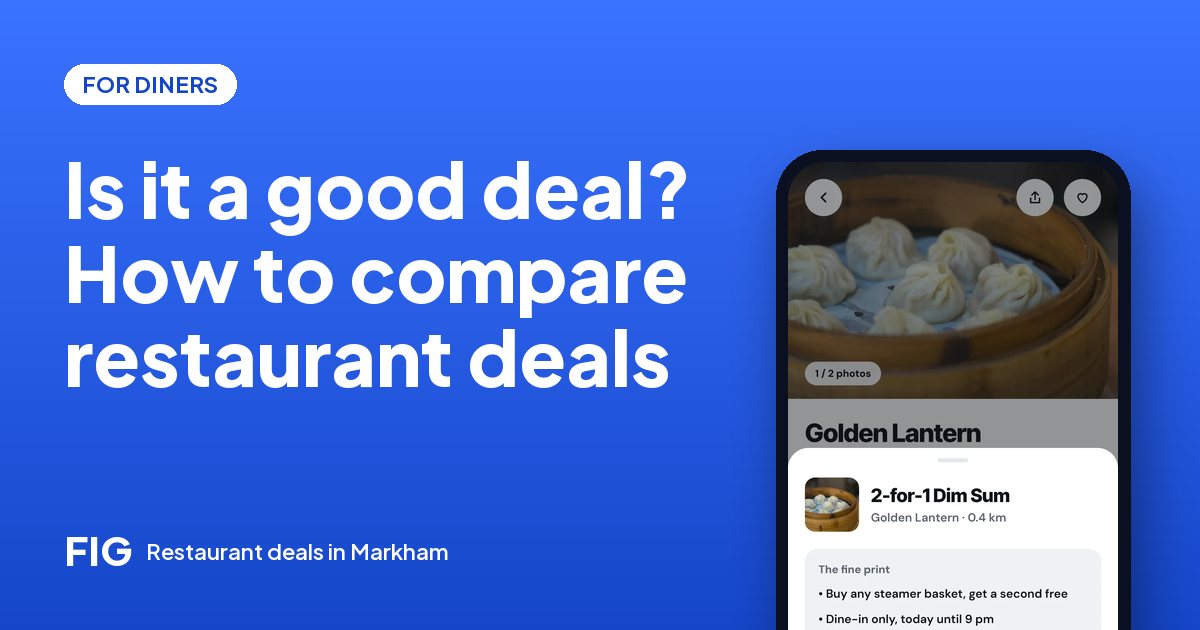
- Check the fine print in the app: which dishes, which days and hours, dine-in or takeout, and the daily cap.
- Tax is worked out after the deal, so a deal also lowers the HST you pay.
The short answer
A good deal lowers what you pay for a meal you were already planning to have. To compare two deals, work out the final price you would pay for the same food, not the headline: $3 off, 20% off and 2-for-1 sound different but only the end price tells you which one is cheaper. Then check when it runs, which dishes it covers and whether you can get there before it ends.
Step 1: start with the food, not the deal
The biggest mistake with any deal is ordering something you did not want because it was discounted. A $6 saving on a $20 dish you would never choose is a $14 loss. Decide what you feel like eating, then look for the deal that fits it. On FIG you can set what you crave, your budget and your diet once, and Home and the map show live deals that fit, nearest first. Deals start in Markham on January 1, 2027.
Step 2: turn every deal into a final price
Take the dish you want and work out what you pay under each deal. Here is a $16 dish, using round example prices:
| Deal | How it works out | You pay | You save |
|---|---|---|---|
| 20% off | $16.00 − $3.20 | $12.80 | $3.20 |
| $3 off | $16.00 − $3.00 | $13.00 | $3.00 |
| 2-for-1, with a friend | $32.00 for two, pay $16.00, so $8.00 each | $8.00 each | $8.00 each |
| Free $5 drink with a main | $16.00 + a drink you would pay $5.00 for | $16.00 for both | $5.00, only if you wanted the drink |
On a single $16 dish, 20% off beats $3 off by 20 cents. On a $12 dish the order flips: 20% is $2.40, so $3 off wins. The break-even is $15, where 20% off and $3 off are the same.
The 2-for-1 saves the most per person, but only if you have someone to share it with and you each want the dish. Alone, it is just a full-price dish.
Step 3: remember the tax moves with the price
In Ontario, HST is 13% and it is worked out on what you actually pay after the restaurant's own discount, the same way a store coupon lowers the price before tax. That means a deal also lowers your tax. On the $16 dish with 20% off, you pay $12.80 plus $1.66 of HST, so $14.46. At full price it would be $16.00 plus $2.08, so $18.08. The deal saved you $3.62 at the till, not just $3.20.
One small exception: prepared food and drinks that total $4 or less in one sale get the 8% provincial part rebated at the till, so only the 5% GST applies. That is general information, not tax advice. More on the $4 rule and eating out on a budget.
Step 4: compare the place, not just the deal
A deal at an expensive restaurant is not automatically cheaper than the regular price at a cheaper one. Do the sum on the dish you would actually order:
- Place A sells the dish at $14.00, no deal.
- Place B sells it at $18.00 and has 25% off: $18.00 − $4.50 = $13.50.
- Place B with $3 off instead: $15.00. Now Place A is cheaper by $1.00.
A 25% deal on an $18 dish beats a $14 dish by 50 cents. A $3 deal on the same dish does not. The bigger the discount percentage, the more a pricier menu can still come out ahead.
Step 5: read the fine print before you claim
A deal that does not apply to your order saves you nothing. Before you tap Claim, check:
- Which dishes. Some deals apply to the whole order, others to specific dishes you will see on the restaurant's menu.
- Days and hours. Many deals run only in quiet hours, such as weekday afternoons and early evenings.
- Dine in or takeout. Some deals are for eating in only. Others also work as takeout, paid in the app, and you pick the food up.
- The daily cap. A popular deal can run out for the day, so claim before you leave.
- The end. A claim stays until the deal ends. A flash deal ends when its timer does.
If you are unsure how it applies to your order, call the restaurant first. How a deal works from claim to counter.
Step 6: price in the extras
Drinks, sides and desserts are usually full price, and they are where a cheap meal stops being cheap. A deal on the main is still a good deal if you keep the extras modest. Here is the whole bill for two people on a 2-for-1, example prices:
- Two $16 dishes on a 2-for-1: you pay $16.00.
- Two $4 drinks at full price: $8.00.
- Food total $24.00, HST at 13% is $3.12, bill $27.12, so $13.56 each.
- Without the deal: $32.00 + $8.00 = $40.00, HST $5.20, bill $45.20, so $22.60 each.
The deal saved $18.08 on the bill, $9.04 each. Most of the saving is the dish. The drinks were never discounted.
Takeout deals, with the same sums
When a deal allows takeout, you order from the menu in the app, the deal comes off, and you pick it up. There is no delivery fee, and FIG adds no service fee. You pay the menu price minus the deal, plus tax, so the same arithmetic as above applies. A $24 order with $4 off is $20.00 plus $2.60 of HST, $22.60 in total. How takeout with a deal works.
Group deals: share the saving fairly
When a deal saves money for the table, agree how to share it before the bill arrives. The simple rule is that the people whose dishes the deal covered share the saving. Example prices: four friends order two $15 bowls on a 2-for-1, plus a $12 bowl and a $14 bowl. Food is $56 before the deal and $41 after it, so the deal saved $15. Whoever ate the 2-for-1 bowls splits that $15 between them: $7.50 each. That is fairer than splitting the bill evenly, where the two people who ordered the cheaper dishes quietly cover part of the saving. Splitting the bill fairly, with the arithmetic.
Know when to skip a deal
Some deals are not worth chasing. Skip it if you would have to travel far out of your way for a few dollars, if the dish is not one you like, or if the hours mean rushing a meal you wanted to enjoy. A deal is a bonus on a good plan, not a reason for a bad one. Because FIG shows every live deal near you, nearest first, there is usually another one close by, and a claim does not time out while the deal runs, so you can claim now and go when it suits you.
A quick checklist
- Would I order this dish anyway?
- What is my final price under this deal, and under the next best one?
- Does it cover the dishes, the day and the hour I am going?
- Can I get there before it ends, and is there room if I am going with a group?
- Have I counted the drinks and sides?
If you can answer yes to the first four and the fifth does not worry you, claim it. If not, the next deal is probably already live. FIG is free for diners, with no ads for now.
Questions
Is 2-for-1 better than 20% off?
For two people who both want the dish, 2-for-1 saves more: 50% each. Alone, it saves nothing, and 20% off is better. Work out the final price for your order.
Is $3 off or 20% off better?
On dishes over $15, 20% off saves more; under $15, $3 off does. At exactly $15 they are equal. These are round example numbers.
Does a restaurant deal lower the tax I pay?
Yes. In Ontario, HST is calculated on the price after the restaurant's own discount, like a store coupon, so a smaller price means smaller tax. This is general information, not tax advice.
Do I pay FIG anything to use a deal?
No. FIG is free for diners, with no ads for now. For dine-in deals you pay the restaurant at the counter as usual.
Can I use a deal on takeout?
Only if the restaurant marked that deal as Dine in or takeout. Takeout is paid in the app, and there is no delivery or service fee from FIG.
What if a deal runs out before I get there?
A daily cap can end a deal for the day, and a flash deal ends with its timer. An expired claim never counts against you.
How do I check that a deal fits my order?
Open the deal and check the dishes, days, hours and whether it is dine in or takeout. You can also call the restaurant before you go.