Key takeaways
- Find your real quiet hours from your own receipts, and aim deals only at those hours.
- Make deals specific (a dish, a time, a price) and cap them per day so they can't cost more than planned.
- Check the math: a deal in an empty hour only needs to cover its food cost to add money.
- Use flash deals for surprise quiet spells, and takeout to fill the kitchen without filling tables.
- Measure claims, scans and return visits per deal; keep what works and pause the rest.
The short answer
To fill slow hours without hurting your margins, aim a specific, capped deal at exactly the hours that are empty, put it where people are deciding where to eat, and measure whether it brings new diners back. A deal in a quiet hour only has to cover its own food cost to add money, because the alternative is an empty table that earns nothing.
Here are seven ways to do it, in the order we'd try them.
1. Find your real quiet hours
Don't guess. Pull a few weeks of receipts (most point-of-sale systems can show sales by hour) and mark each hour of the week as busy, steady or quiet. For many restaurants the quiet hours are weekday afternoons, roughly 2 to 5 pm, and early weeknights. Yours might be different: a lunch spot near offices can be dead on Saturdays.
Seven columns (days) by your opening hours (rows). Fill each cell with the average number of tables or orders. The cells with the lowest numbers are where a deal does the most good and the least harm.
2. Make the deal specific
"2-for-1 dumplings, Monday to Thursday, 2 to 5 pm" beats "10% off". A specific deal is easier to share, easier for staff to honour and easier for a diner to decide on. On FIG a deal can be a percentage off, a dollar amount off, 2-for-1, or something free with an order, on the whole bill or on specific dishes from your menu, and it can run on chosen days and hours every week, once, or until a date. Which deal type to pick, with worked examples.
3. Do the math, then cap it
Restaurants in Canada run on thin margins: Statistics Canada put the 2023 operating profit margin for food services and drinking places at 3.6%. That's why the deal has to be right. The key idea: in an hour that would otherwise be empty, the deal only needs to cover its food cost to add money, because rent, wages and the lights are being paid either way.
- Food cost at 30% (the industry average is 28% to 32%): $4.80 a plate.
- 20% off: the diner pays $12.80. Left after food cost: $8.00 a plate.
- 2-for-1: two plates for $16. Food cost $9.60. Left: $6.40 for two plates.
- An empty table at 3 pm: $0.
Both deals add money in an empty hour. At 7 pm on a Saturday, when the table would have sold at full price, the same 2-for-1 loses you about $16. That's why the hours matter more than the discount.
Then cap it. A daily cap on FIG stops the deal automatically once it's been used that many times, so a deal can never cost more than you planned. Start small (say 10 a day), watch it for two weeks, and raise it if it's working.
4. Go where people are deciding
Most people decide where to eat on their phones, often in a group chat, a few minutes before they go. A poster in the window reaches people who are already there. A deal on a map of nearby deals reaches people who are deciding right now. On FIG, live deals show on Home and the map, nearest first, and diners can send a restaurant's link to their group chat, which opens its page with its live deals.
5. Use flash deals for surprise quiet spells
Rain, a cancelled reservation, a slow lunch you didn't see coming. A flash deal is a short deal you post on the spot: pick the deal, how long it runs and an optional cap, and it's live near you within seconds, with a real timer. When the timer ends, it's gone. How flash deals work.
6. Fill the kitchen, not just the tables
Some hours the dining room stays quiet but the kitchen has room. A deal diners can order as takeout and pick up fills that capacity without filling seats, and diners pay no delivery fee. On FIG you choose which deals work as takeout, and you can pause takeout or add prep time when the kitchen gets busy. Diners pay for takeout in the app; FIG keeps 5% of the food, plus Stripe's card fee. How takeout with a deal works.
7. Measure, keep, pause
Give each deal two weeks, then look at three numbers:
| Number | What it tells you |
|---|---|
| Claims | Is the deal interesting? Low claims: the deal or its photo isn't pulling. |
| Scans | Are people actually coming in? Many claims but few scans: the hours or the distance may be wrong. |
| Return diners | Is it building regulars? This is the number that pays off long after the deal. |
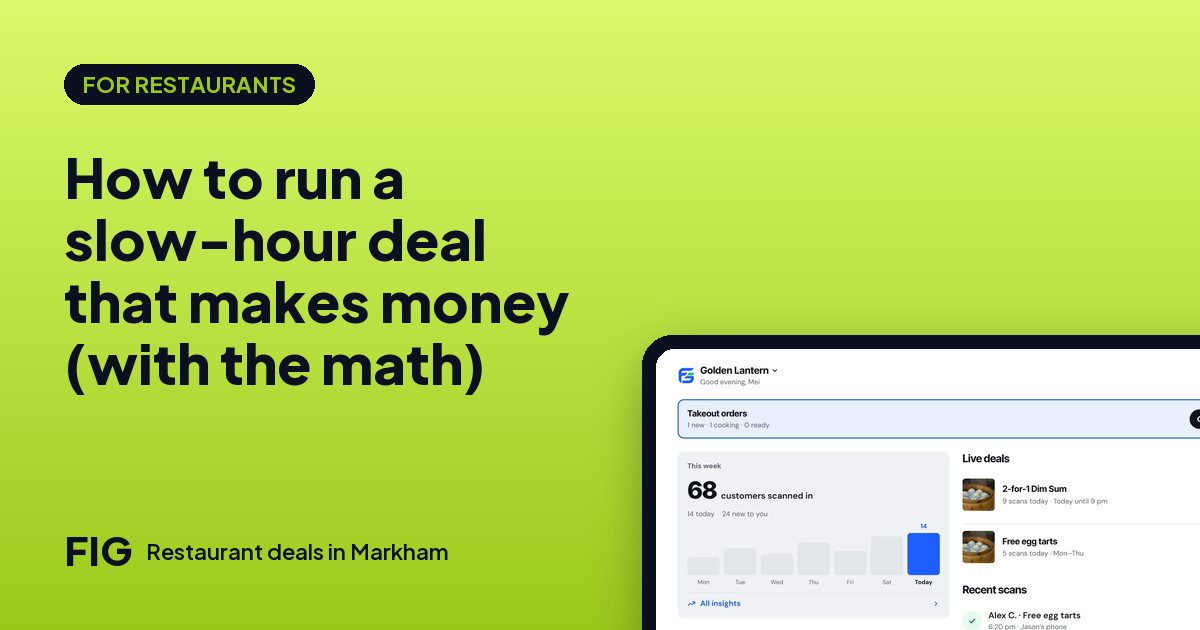
FIG's insights show views, claims, the diners who came in and who came back, per deal, day by day. Keep the deals that bring new people back. Pause the rest with one tap.
A one-week plan
- Monday: mark your quiet hours from last month's receipts.
- Tuesday: pick one dish with a healthy margin and write one specific deal for one quiet window.
- Wednesday: post it on FIG with a cap of 10 a day. Take a good photo.
- Thursday to Sunday: make sure every staff member knows the deal and how to scan.
- Two weeks later: check claims, scans and return diners. Adjust the hours, the dish or the cap.
Setting up on FIG takes about 15 minutes. A 15-minute setup guide for your menu and takeout.
Questions
What's the cheapest way to market a small restaurant?
Aim a specific, capped deal at your quiet hours and put it where diners are deciding. On FIG, posting deals and scanning diners are included in one flat plan, with no fee per diner.
Will a deal hurt my margins?
Not if it runs only in hours that would otherwise be empty and covers its food cost. Cap it per day so it can't cost more than planned.
What are the slowest hours for restaurants?
For many, weekday afternoons (about 2 to 5 pm) and early weeknights. Check your own receipts by hour: every restaurant is different.
Should I offer a percentage off or 2-for-1?
2-for-1 pulls hardest but costs the most per plate; a percentage off is gentler on margin. Run the numbers on your food cost first.
How do I know if a deal is working?
Watch claims, scans and return diners for two weeks. FIG's insights show all three per deal.
Can I stop a deal anytime?
Yes. Pause or end it with one tap, and the daily cap stops it automatically each day.